Peer Review Process
INFONEX: Journal of Informatics and Next Generation Technology applies a double-blind peer review system, in which the identities of both authors and reviewers are concealed to ensure objectivity, fairness, and academic integrity in the evaluation process.
Each submitted manuscript undergoes an initial editorial evaluation and is then reviewed by at least two reviewers with expertise relevant to computer science, informatics, and emerging digital technologies. The review process is conducted systematically, objectively, and professionally to ensure the scientific quality and originality of the manuscript.
The overall review process is targeted to be completed within a maximum of 30 days, with each reviewer expected to complete the review within 10 working days. If a reviewer is unable to complete the review within the specified time, the editor may assign a replacement reviewer.
During the review process, manuscripts are evaluated based on the following criteria:
- Consistency between the title, abstract, introduction, methodology, results, discussion, and conclusion
- Novelty and scientific contribution
- Relevance to the journal’s focus and scope
- Methodological quality and validity
- Clarity of presentation and academic writing
- Quality, relevance, and adequacy of references
Stages of the Review Process
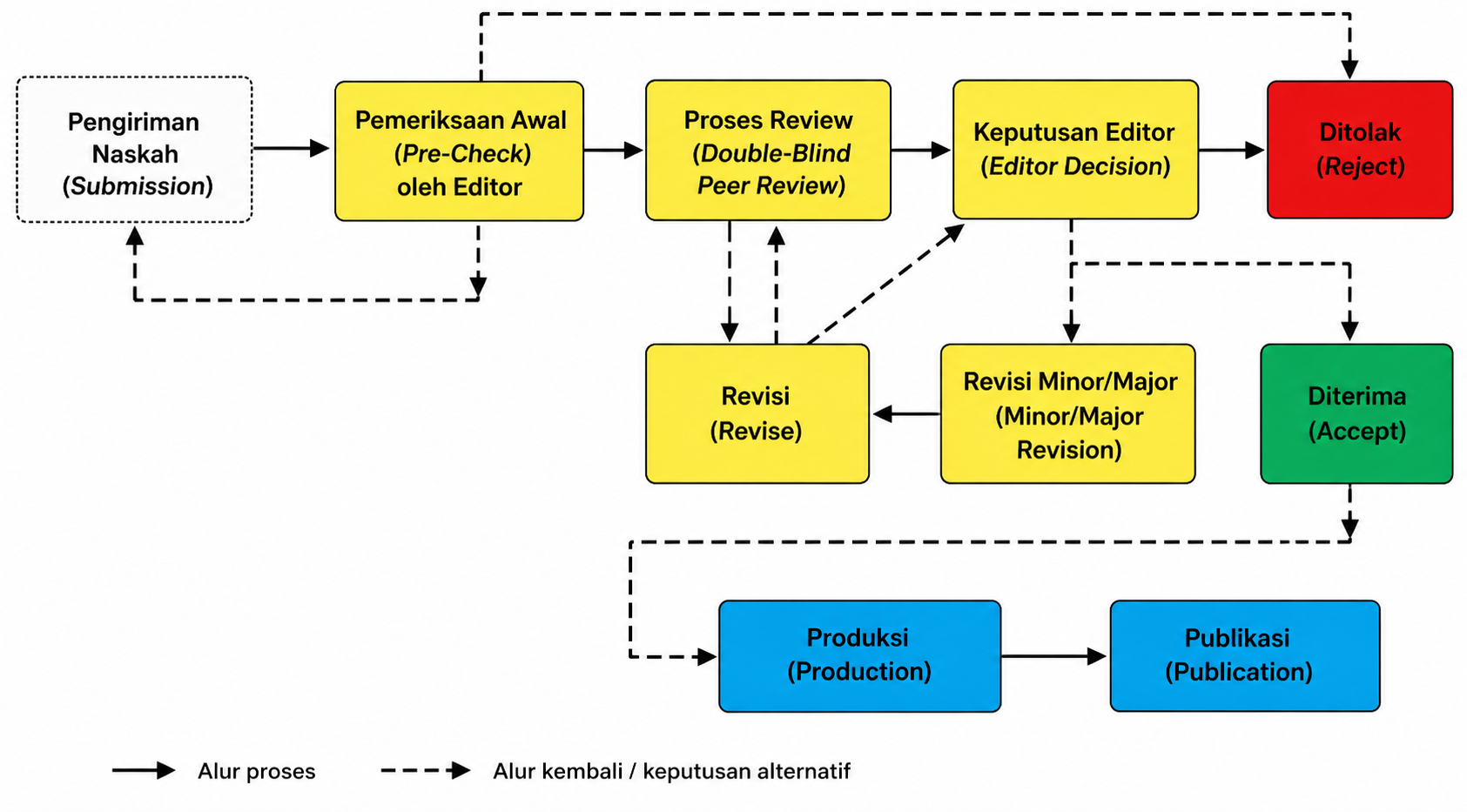
1. Submission
Authors submit their manuscripts through the journal’s online submission system (Open Journal Systems/OJS).
2. Initial Editorial Evaluation (Pre-check)
The editor conducts an initial screening to evaluate:
- Alignment with the journal’s aims and scope
- Completeness of manuscript components
- Compliance with the journal template and author guidelines
- Similarity and plagiarism screening
- Basic academic writing quality
Manuscripts that do not meet these requirements may be rejected or returned to the authors for revision before proceeding to the review stage.
3. Peer Review Process (Double-Blind Review)
The manuscript is assigned to at least two independent reviewers for evaluation based on originality, scientific contribution, methodological quality, technical accuracy, relevance, and clarity of presentation.
Reviewers provide recommendations and constructive comments to help improve the manuscript quality.
4. Editorial Decision
Based on reviewers’ comments and recommendations, the editor makes one of the following decisions:
- Accepted without revision
- Accepted with minor revisions
- Accepted with major revisions
- Rejected
5. Revision by Authors
Authors are required to revise their manuscripts according to reviewers’ and editors’ comments within the specified revision period.
Revised manuscripts may be returned to reviewers for further evaluation if necessary.
6. Production
Accepted manuscripts proceed to the production stage, including:
- Copyediting
- Layout editing
- Proofreading
- Metadata preparation and DOI registration
7. Publication
The final version of the article is published online according to the journal’s publication schedule and becomes freely accessible under the journal’s open access policy.
Publication Decision Policy
The final decision regarding manuscript acceptance is made by the Editor-in-Chief by considering reviewers’ recommendations, editorial evaluations, manuscript quality, and compliance with the journal’s policies and ethical standards.
The order of publication is generally determined based on the completion of the review and production process while maintaining balanced publication management.
Additional Notes
- All review and editorial processes are conducted confidentially and professionally
- Authors will receive notifications and updates at each stage of the review process
- Editors reserve the right to reject manuscripts that do not align with the journal’s scope or fail to meet scientific and ethical standards
- Reviewers are selected based on expertise and academic competence relevant to the manuscript topic